
TRADITIONAL AGENT STACK5+ systems · 4 handoffs
01Agent frameworkHTTP + JSON ↓
02Vector / graph databaseHTTP + JSON ↓
03Rule or solver serviceHTTP + JSON ↓
04Workflow orchestratorHTTP + JSON ↓
05Audit & observabilityreconstruct trace
A server-side language for AI agents. Natural enough to generate. Structured enough to trust. One runtime from intent to verified action — no glue code, no handoffs.
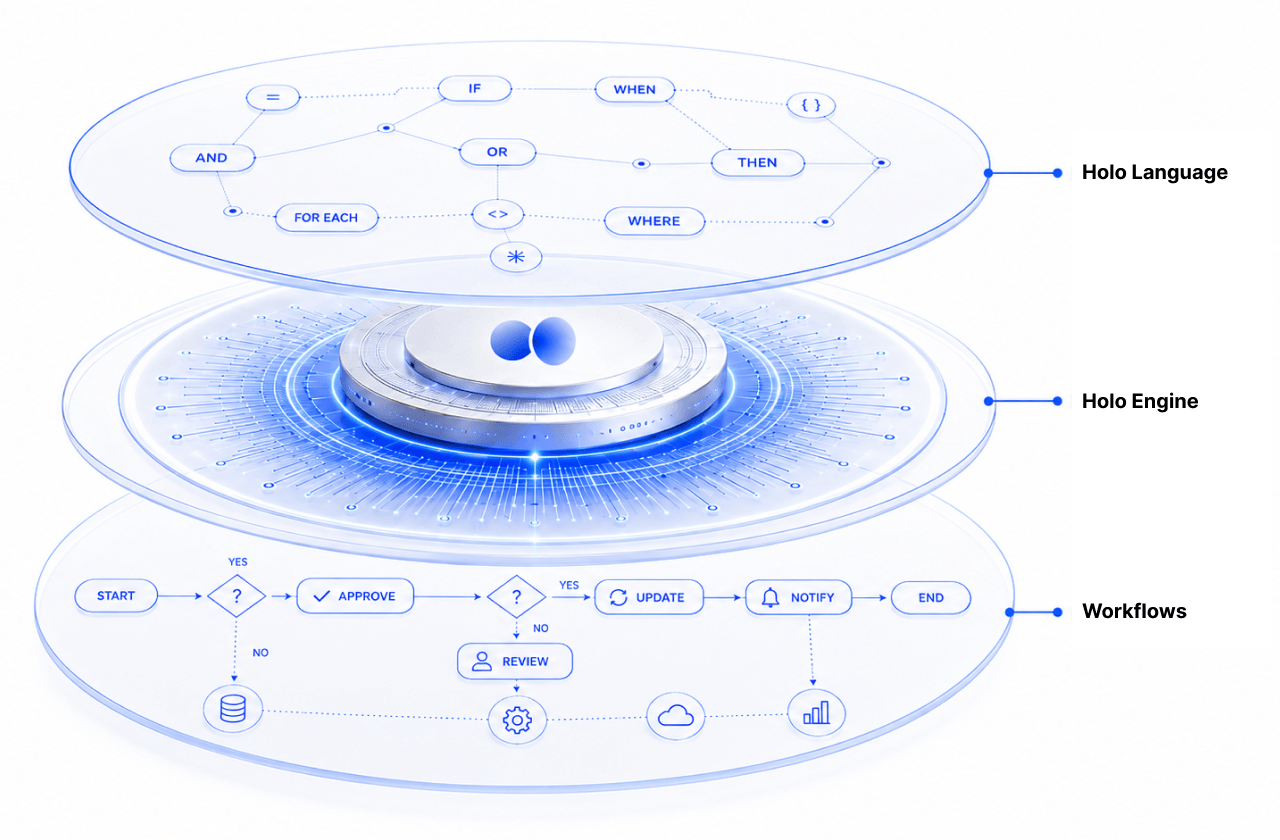
Traditional agent stacks split every step across separate systems. Each handoff is where context is lost and verification fails. Holo Language runs the full cycle in one program — one state, zero handoffs.
Natural-language-inspired syntax that's compact and legible. Agents generate it. Humans can read and audit it.
Twenty cognitive endpoints run in-process on one tenant store. No HTTP roundtrip, no JSON serialization between logic and engine.
Variables, functions, objects, frames and trace live in an inspectable tree structure — not an opaque heap. Debug, audit, replay.
With a tenant context, Holo endpoint functions operate directly on the shared store. Map values move from interpreter to engine core and back without an internal HTTP roundtrip or JSON serialization.
In a conventional agent stack, every handoff serializes context and creates another place for state to drift. Holo runs the workflow where the state already lives.
01Agent frameworkHTTP + JSON ↓
02Vector / graph databaseHTTP + JSON ↓
03Rule or solver serviceHTTP + JSON ↓
04Workflow orchestratorHTTP + JSON ↓
05Audit & observabilityreconstruct trace
A single inspectable AdelicTree holds the state and trace
Four serious workflows verified on Holo Engine: payload-adaptive robotics, balance recovery, chip power optimization, and exact footstep planning.
The interpreter and engine core share one address space. Cognitive functions are direct calls, not network requests.
Every variable, function, object, and execution event lives in a structured tree you can inspect at any point. Debug, audit, and resume execution state.
Instead of debugging through HTTP logs and scattered state stores, you inspect one tree that holds the entire execution context.
State, interfaces, concurrency, automation and direct access to Holo Engine — all in one compact syntax.
Variables, functions, objects, frames and trace live in an inspectable AdelicTree — not an opaque flat heap.
Keep variables and structured agent state across calls with a session_id. Snapshots make the running state inspectable.
Twenty core endpoints run in-process on one tenant store, removing internal HTTP and JSON serialization.
Dynamic types, maps, lists, objects, recursion, closures, first-class and higher-order functions.
spawn, await and multi-producer channels coordinate real OS-thread tasks with capture-by-value.
Register authenticated webhook endpoints and call the same endpoints in-process without HTTP.
Intervals, one-shot jobs and data_changed reactions persist in the tree and resume after restart.
HTTP, JSON, CSV and file operations turn Holo programs into complete server-side workflows.
A compact, explicit syntax lets AI agents generate complete executable workflows instead of stitching together tool calls.
Use spawn, await, channels and parallel HTTP to express fan-out/fan-in workflows directly. Multiple agents or cognitive calls can work simultaneously and converge into one result.
Schedules and triggers are persisted in the tenant's AdelicTree. Holo can run jobs later, repeat them, react to named signals or tenant data changes, and expose callable webhooks.
Run the same Holo block repeatedly on a fixed cadence.
Schedule work for later and automatically deactivate it after execution.
React to a signal — including changes to tenant data.
Turn Holo logic into an HTTP endpoint callable by external systems.
A LANGUAGE FOR THE AGENTIC ERA
AI agents do more than calculate. They must remember state, retrieve knowledge, reason, solve constraints, act, wait, react, and prove what happened. Holo Language makes those operations native parts of one program.
Natural enough to generate. Structured enough to trust. Powerful enough to orchestrate the full decision cycle.